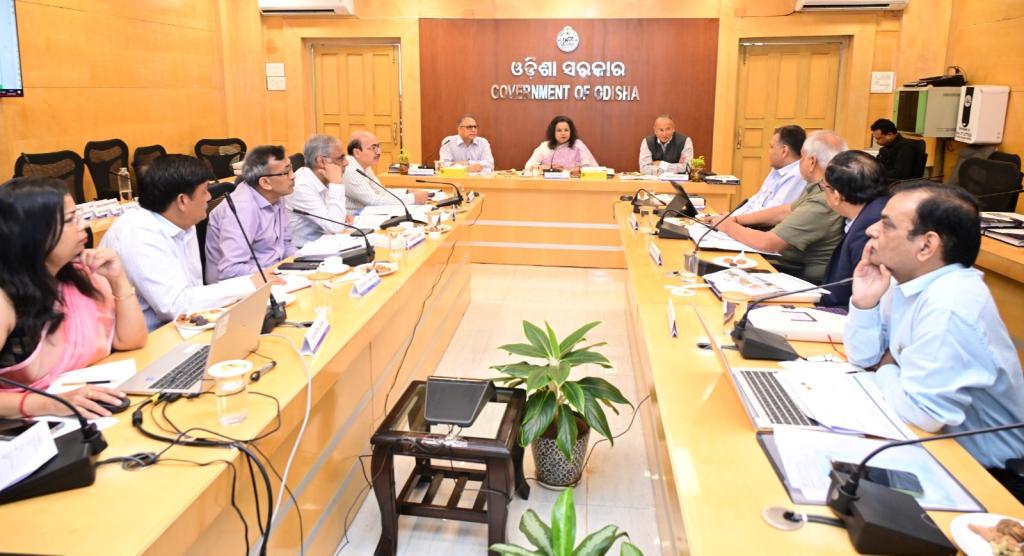
Paperman Media (Bhubaneswar )- The 29th Board Meetings of power distribution companies (DISCOMs) responsible for supplying electricity in different parts of Odisha were held individually under the Chairpersonship of Ms. Anu Garg, IAS, Chief Secretary, Odisha. The meetings held at Lokseva Bhawan on 22nd April, 2026, reviewed the performance, operational efficiency, and ongoing initiatives of various DISCOMs, including TP Northern Odisha Distribution Limited (TPNODL), TP Southern Odisha Distribution Limited(TPSODL), TP Central Odisha Distribution Limited(TPCODL) and TP Western Odisha Distribution Limited(TPWODL).
Key issues such as power supply reliability, loss reduction, consumer service delivery, and infrastructure development were discussed to ensure efficient and uninterrupted electricity supply across the State.
Odisha is witnessing a strong push towards clean energy adoption under the PM Surya Ghar: Muft Bijli Yojana (PMSG-MBY), which was launched on 13 February 2024 with a total outlay of ₹75,021 crore and is being implemented up to FY27.
To accelerate rooftop solar adoption, the Utility-Led Aggregation Scheme (ULA) has been introduced by the Ministry of New and Renewable Energy, Govt. of India. In Odisha, the scheme launched in November 2025, enables domestic consumers with a 1 kW connected load to install rooftop solar systems at a highly subsidized contribution of just ₹1,875.
The State has reported encouraging installation progress under both schemes. As per report, 55,888 installations have been completed under PMSG-MBY, while the ULA scheme has contributed an additional 29,000 installations, taking the total to 84,888 rooftop solar systems across the State. Significantly, Odisha’s achievement under the ULA scheme is the highest in the country, highlighting the State’s effective implementation strategy and rising consumer participation in renewable energy adoption.
Odisha has set an ambitious target of bringing 3 lakh households under rooftop solar coverage, marking a significant step in its clean energy transition. So far, the State has achieved 83,979 RTS installations, reflecting steady progress on the ground. To fast-track implementation, authorities are now gearing up to scale the pace to 25,000 installations per month in the coming phases. The District Collectors of Cuttack and Ganjam have extended financial and administrative support to three villages Matiakhal (200 households), Olaba (41 households) and Debabhuin (29 households) covering a total of 280 households. Commissioned in February 2026, the initiative has successfully ensured that all beneficiary households now receive electricity with zero monthly bills, significantly reducing the financial burden on families while improving quality of life.
Robust operational performance has resulted in significant reduction of aggregate Technical and Commercial (AT&C) losses from 29.5% in FY 2019-20 to 14.6% in FY 2025-26. TPNODL was ranked 2nd and TPCODL was ranked 4th in Distribution Utilities Ranking for Non-Urban Distribution Utilities. No increase in retail tariffs for the last five years. The Odisha Discoms have spent ₹17 Crore under Corporate Social Responsibility in FY 2025-26 and plan to spend ₹20 Crore in FY 2026-27. These initiatives are aimed at enhancing access to primary healthcare services in remote locations and building livelihood opportunities through various programs. For healthcare of remote villages in Odisha, 16 Nos. of Mobile Health Dispensaries have been operationalized in 2025-26. 4 Nos. of additional Mobile Health Dispensary will be deployed in FY 2026- 27. To enhance employability and employment opportunities, 20 Nos. Vocational Training Centres are operational across Odisha in FY 2025-26. This will be increased to 24 Nos. in FY 2026-27.
While reviewing all Boards performances, the Chief Secretary has urged prompt and effective redressal of public grievances related to power supply. She also emphasized the importance of ensuring quality and safety in power distribution services. She further highlighted the importance of initiatives such as the PM Surya Ghar scheme in promoting clean and sustainable energy access, and emphasized the need to enhance Corporate Social Responsibility (CSR) activities.